

“We cannot walk alone. And as we walk, we must make the pledge that we shall always march ahead.”
~ Dr. Martin Luther King, Jr.,
I Have a Dream, August 28, 1963, The March on Washington for Jobs and Freedom
“For the creation eagerly waits with anticipation for God’s sons to be revealed. 20 For the creation was subjected to futility—not willingly, but because of him who subjected it—in the hope 21 that the creation itself will also be set free from the bondage to decay into the glorious freedom of God’s children.”
~ The Apostle Paul to the church at Rome
(Romans 8:19-21, CSB)
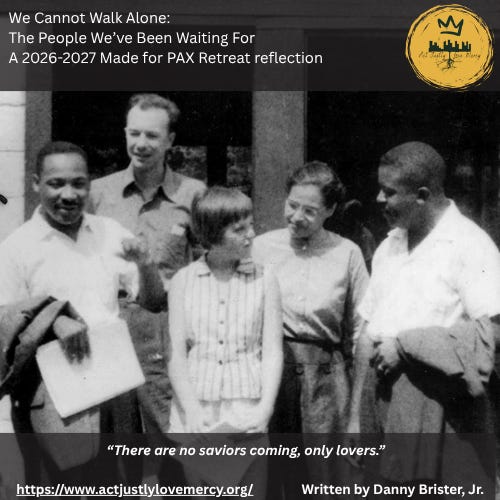
I was recently on a call with Black leaders throughout the Southeast. What drew us together was love. Love for people and our communities. You had school leaders, ministry leaders, organizational leaders, entrepreneurs, and pastors.
We were talking about the K-shaped economy's impact on communities of color throughout the Southeast. My friend and mentor, Cornelius Williams, founder and president of Resurgence Leadership Foundation in Atlanta, GA, called the meeting and shared that he’d been sitting with something for several months and had reached a point where he didn’t want to sit with it alone. He then raised the question, "Is there something we could build or carry together that none of us can sustain alone?"
It became abundantly clear that if things are going to get better, it will require these people, and people like them, to keep showing up for their communities. But after diagnosing the problems, it was also clear that there is a lack of support for the people our cities and country need most. What happens when the people who care run dry? Who is thinking about their well-being?
The Folk School
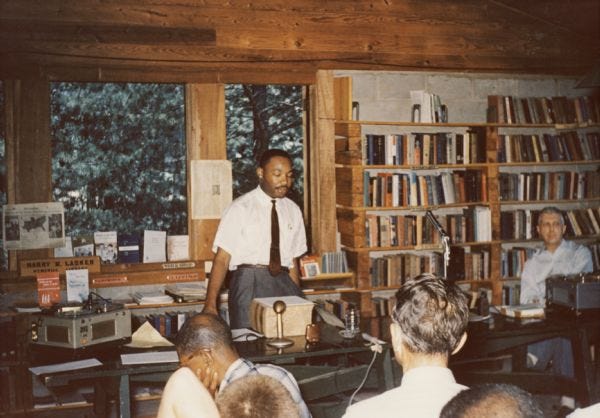
In 1932, Myles Horton started Highlander Folk School in rural Tennessee. A devout student of the theologian Reinhold Niebuhr, Horton launched Highlander as a way to both train and convene labor organizers and to provide adult education, but later shifted toward race relations. Highlander’s legacy is that it provided a safe place for passionate people to come together, be encouraged, and be enriched by being with brothers and sisters on the same journey to restore a nation that wasn’t well. To see it live up to its highest ideals and loftiest creeds, and ultimately experience shalom and well-being. To see it healthy.
Highlander welcomed such people as Rosa Parks (four months before she was arrested for refusing to give up her seat on a Montgomery, AL, bus), Diane Nash, and Marion Barry, most of whom sat under the tutelage of Septima Poinsette Clark — one of the founders of the Citizenship Schools and mother to the Movement.
If a movement is going to be successful, there must be people and institutions that marry both the core teachings and the movement's commonalities—creating a sense of belonging among those inspired by the cause. These institutions provide the practical skills of advocacy, activism, and alignment. Movements die when they lose their moral compass or their togetherness. What Highlander and later the Southern Christian Leadership Conference (SCLC) provided was a place to be moored in nonviolence, citizenship, and the truth of the gospel.
Citizenship Education Program
We often celebrate the known leaders of the Movement, and those who undergird its daily existence are often overlooked. But what Dorothy Cotton, Andrew Young, and Septima Clark (the core leaders of the Citizenship Education Program for SCLC) knew was that if they could not effectively train, mobilize, and foster unity among grassroots leaders, the movement would eventually collapse under the weight of violent oppression. At the core of this was the pursuit of the activists’ well-being. In their fight to restore their cities and towns, they were to learn the joy of being made well together.
The Marshall Field Foundation in Chicago had already taken an interest in the Citizenship Schools, funding efforts to expand the model beyond Johns Island, South Carolina, where it was originally implemented. So when Tennessee moved against Highlander in 1961 and revoked its charter on falsified charges that the school was being run for profit, the question wasn’t only whether the school would survive. It was a question of whether the program and the grant would survive with it. Highlander transferred both to the SCLC. Because SCLC had no tax-exempt status, the American Missionary Association had to administer the $26,500 grant on its behalf. Tennessee did not close Highlander for failing. It closed Highlander for working, and the work marched ahead anyway, because it had already been planted in people.
Andrew Young, having already agreed to move his family from New York to Tennessee when Highlander’s doors were padlocked, came with the program. He was appointed by SCLC to direct the CEP after its closure. Early on, he wrote a letter to Dr. King, saying he felt like an intruder at SCLC because King had never asked for him. The man who would go on to direct the program that built and sustained the latter half of the Movement began by wondering whether he belonged in the room. Alongside Septima Clark and Dorothy Cotton, he trained teachers at the Dorchester Center in Liberty County, Georgia — and by the time the program ended in 1970, roughly 2,500 trained teachers went on to teach what they had learned to tens of thousands of their neighbors.
“The Black elected officials and political leaders across the South were full of people whose first involvement in civil rights came through the Citizenship Training Program.”
~ Andrew Young
The Birth of the Citizenship Schools, History of Education Quarterly, Fall 2004, David Levine
The Birmingham Campaign of 1963 doesn’t happen without the pre-work of the CEP; Freedom Summer throughout Mississippi doesn’t happen without the work of Ella Baker and her nurturing of the Student Nonviolent Coordinating Committee; and neither do the events of Selma, Alabama, that led to the Voting Rights Act of 1965. Those who sought the well-being of others were cared for by the love and compassion of a few.
Change isn’t possible without those who lead diligently, nurturing the faith and veracity of others through patient instruction and intentional pursuit.
Modern Day Movement
So when I set foot on the grounds of the Franciscan Renewal Center in 2025, I knew that I’d found the modern-day embodiment of the historic work of the Highlander Folk School.
In Scottsdale, Arizona, I was introduced to MADE for PAX, an organization whose mission is to provide contemplative activism and cultural identity formation for Christians of color pursuing a world made whole. I spent nine months growing both as a writer and a contemplative. This year I returned not as a fellow, but as a facilitator, with the honor of leading the inaugural Men In Leadership cohort.
What MADE for PAX is doing is creating a community of belonging by equipping those called to engage in the work of peacemaking while also living lives rooted in loving union with Christ. It has stationed itself at the intersection of contemplation and activism.
Contemplative Christianity is the practice of slowing down to be with Jesus.
Activism is the pursuit of a rightly ordered world.
Contemplative Activism calls people to the work of stillness and struggle. To see the world made whole not from our busy doing, but from being with Jesus. That our doing flows out of our being. It runs counter to most modern-day approaches, which are hurried in their spirituality and humanistic in their activism.
The People We’ve Been Waiting For
I am currently writing a series titled No One Is Coming. I took those words from Geoffrey Canada, founder of the Harlem Children's Zone, who described learning as a boy that Superman wasn't real. He grieved not the character but what his absence meant. No one with enough power was coming to save his neighborhood. If things were going to change, it would come from the people already inside it, deciding to do something about the pain and injustice they lived with daily.
While there are no saviors coming to the rescue, there are people like the PAX fellows, alumni, and facilitators leading the way in communities across the country, seeking the well-being of the marginalized and the broken. People like Maya Wilson, who writes and hosts a podcast at the intersection of theology, culture, and the Black experience, teaching us to see God in the everyday. Tiffany Bluhm, the executive director of MADE for PAX, whose passion for justice and for creating space for BIPOC leaders runs in the same vein as Ella Baker and Septima Clark. Drew Jackson and Armando Canchola-Scott, public theologians and contemplatives who helped start MADE for PAX while serving the local church and the broader one. What they share is a conviction that we learn from the past while leaning into an uncertain future by abiding in Jesus and loving our neighbors. Forming people in the ancient ways of the desert mothers and fathers, and sending them back out in love.
When Myles Horton wrote his autobiography, he titled it The Long Haul. He understood that this journey was more akin to an arduous cross-country trek than a short, leisurely drive. These leaders are helping to fuel and sustain leaders over the long haul.
Brothers and Sisters
We had men from across the country; pastors and nonprofit directors and teachers, husbands, fathers, brothers, and sons, all of them carrying the weight of families, their cities, and a desire for righteousness and justice. There are too few spaces curated for the well-being of men of color. Most of the voices shaping them reduce them to their productivity, their sexuality, or their fitness, and almost none of it accounts for the weight a man carries when he is trying to be present, faithful, and fruitful all at once. So they arrive tired, but ready, ready to learn to rest and grow. They are men who dream of creating spaces of belonging, seeing their local school systems create space for all, and desire an honest telling of the history of their people. That’s why I jumped at the opportunity to walk alongside PAX to see men of color find the community they’ve so longed for.
The women in that place are doing the work of justice, love, and renewal across the United States and beyond it, in some of the most impactful ways I have seen. PAX’s executive director called it a resisterhood. These are women who have been overlooked, underpaid, and asked to make themselves smaller in order to keep the work funded and the world going. Since January of last year, hundreds of thousands of Black women have been pushed out of the labor market; the jobs, the grants, the contracts all drying up due to a deliberate assault. And still they came, and still they are building. One woman I spoke with described her passion for Bible translation. She wanted to be a part of helping to translate the scriptures for people who don’t have them in their native tongue. To see these women received into a space that simply says you are welcome here is to watch something get repaired that most rooms keep breaking.
Nearly a hundred years ago, Highlander started by giving passionate people a place to grow and connect who were on the same journey. In a desert retreat center in Scottsdale, Arizona, and across the United States that is still what’s happening through organizations like PAX and others. It’s a different century, with some new and old problems, but the same medicine is needed.
Paul wrote that creation waits with anticipation for God’s children to be revealed. I used to read that as a promise about the end of things, and I still believe a day of cosmic renewal is coming. But I have come to believe the waiting also describes what happens whenever a room like this one gathers and is sent out. The revealing is not one spectacular act, but looks like men and women of color, formed in stillness, sent back to the struggle, carrying one another and the truth and love of Yeshua HaMashiach (Jesus the Messiah).
There are no saviors coming, only lovers. But we were never asked to go alone.
“We cannot walk alone. And as we walk, we must make the pledge that we shall always march ahead.”