

EDITOR’S NOTE:
I originally wrote this series in 2023, and I’ve carried it with me in different ways ever since. The questions it raises have only grown louder. So, I’ve updated and refreshed each post because I believe the village—the work of building it, sustaining it, and belonging to it—is one of the most urgent conversations of our time. I hope it meets you where you are. If my writing has been encouraging to you, then I’d love for you to join me as a patron!
“Who you are is more important than what you do. Why? Because the love of Jesus in you is the greatest gift you have to give to others. Who you are as a person—and specifically how well you love—will always have a larger and longer impact on those around you than what you do. Your being with God or lack of being with God will trump, eventually, your doing for God every time. We cannot give what we do not possess. We cannot help but give what we do possess.”
~ Peter Scazzero, The Emotionally Healthy Leader
We are living in one of the loneliest moments in modern history. In 2023, former Surgeon General Dr. Vivek Murthy declared loneliness a public health crisis. Studies show that Americans have fewer close friendships than any previous generation on record. And yet, there is a growing and urgent conversation—particularly in Black communities—about the need to rebuild our institutions, strengthen our neighborhoods, and recover what it means to be a people who belong to one another.
These two realities are not unrelated. We are lonely, and we are longing. Longing for belonging. Longing for villages.
A friend of mine recently asked me a question that gets at the heart of this tension: “How do we build the village?” That question sits at the center of a much larger conversation about equipping and developing leaders who are rooted in the historic Christian faith and prepared to lead with courage, love, ingenuity, justice, righteousness, character, and truth in the 21st century. People who are formed to carry out the Great Commission (Matthew 28:18-20), the Great Commandment (Matthew 22:37-39), and the Great Responsibility (Micah 6:8). It is not an easy question. But since I have committed so much of my life, time, and study to answering it, I want to share my thoughts.
Villages are made up of people in specific places, at a specific time. The people in a village usually have an agreed-upon set of norms that lead to the flourishing and sustainability of its people. When the social contract in any village breaks down, it usually leads to selfishness, self-centeredness, and injustice—its sin is not just personal but societal. In our culture, the village we often speak of is the African-American community; many Black people see themselves as a village unto themselves. While there are broader villages, this is the one often referred to in Black spaces. If you have read my blog, you know I intentionally write from my Christian-African-American perspective. I do this because that’s who I am, and I want to be authentic to my voice and experience—but the concepts I will share in this series are for everyone.
GOD & OUR ROLE IN THE VILLAGE
A few years ago, I started teaching a group of my students the following framework for self and community transformation. During this time, I mainly taught Black men who were ordered by the justice system to take fatherhood or rehabilitation classes as part of an incarceration deferment program. I loved the time I spent with those men. I watched many of them begin to flourish after months of consistency. But while our curriculum was high-quality, it often failed to reach the core of their hearts in a way that would bring about transformation.
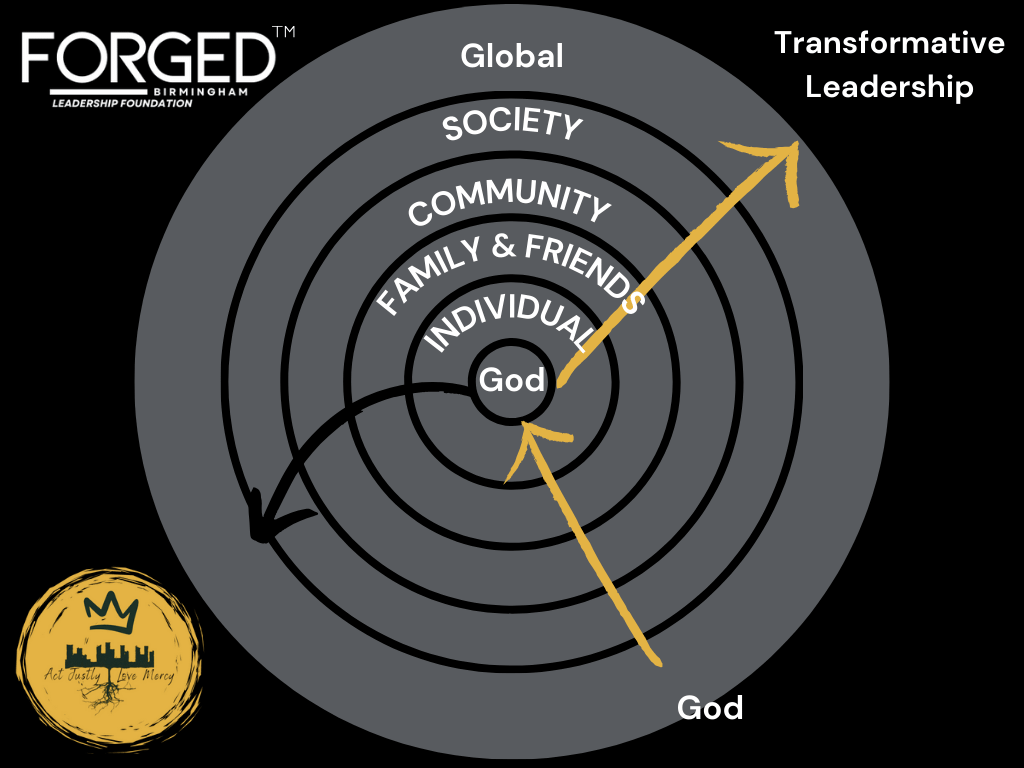
So I developed this framework as a tool to disciple these men. Over the years, I have continued to refine it through my work at Forged: Birmingham Leadership Foundation, where we provide accessible, gospel-centered leadership formation for leaders in our city. What started as a classroom tool has become a framework for how we think about developing whole leaders—people whose inner and outer lives are aligned.
Transformation starts with God entering the individual’s life. An eternal God, through the power of the Spirit and the proclamation of the gospel, comes and makes you new. From there, you come to know the eternal God who has made Himself known to you through His Son Jesus. As you learn who God is and what He has done, you come to understand better who you are and what He is calling you to do. Usually, what happens after that—depending on the context you live in—is you want to make an impact and share all that you’ve received. Instead of jumping ahead to community and society, you have to take a deep look at yourself and your closest relationships, namely your family and friends.
But before we get there, it’s important to understand that you are an essential member of any village. If you don’t come to know that you are created in the image of God and loved deeply (John 3:16-17), then you will never fully comprehend just how much you have to contribute. You also may make the mistake of thinking that your worth comes from what you do and not who you are. That’s why we don’t start with us. We start—or restart—with God.
On your journey of being developed into a leader, you may have picked up valuable skills and tools along the way, but you also may be carrying useless weight. What I mean is we’ve all been hurt, and we’ve all hurt others. Things like unforgiveness, offense, and bitterness can isolate us and hinder our willingness to engage in village building. It can keep us locked in a cycle of self-defeating behavior, several fits of stopping and starting again, and being trapped by sin and sinful habits.
People often limit themselves and their growth because they don’t spend enough time with themselves and don’t think about how to build a village in their own homes or with those who know them best. When I say take a deep look, I mean reflecting on how the gospel that saved you is working itself out in you and around you. Often, the people we hurt first and most are those closest to us. If we are to build villages and places of safety, courage, and transformation in society, we must learn to repair and rebuild our homes and families.
How do you live out the fruit of love, kindness, and gentleness? Do you care about justice? Great! Do you long for a righteous society? Fantastic! How do those two ethics play out in your home and most intimate relationships? Justice and righteousness begin with God and must manifest next in the believer’s life. Taking time to nourish your soul and care for and lead those around you first is a model for longevity.
A NOTE ON SCAZZERO
I opened this piece with a quote from Pete Scazzero’s The Emotionally Healthy Leader, and I want to sit with it a moment longer because it calls us deeper. Scazzero’s central argument is that the depth of your inner life with God determines the health of your outer life in leadership. You cannot sustainably give what you do not possess.
I first encountered this framework 12 years ago, and it has shaped how I think about discipleship and leadership development ever since. I am currently going deeper into this work as a table leader in the School of Emotionally Healthy Leadership, and what I can tell you is that the longer I sit with these ideas, the more convinced I am that this is the starting point for anyone serious about building lives, families, disciples, and institutions that last. We need to recapture a contemplative historic Christianity that goes deeper than our modern and post-modern renderings.
Village building is soul work before it is strategy work. You cannot organize your way into transformation. You cannot program your way into belonging. At some point, you have to reckon with what is happening inside of you, what you carry, what you’ve buried, what God is still trying to heal. You must slow down to be with God, as He invites you to follow Him! The village you want to build on the outside will only be as strong as the work you’ve allowed God to do on the inside.
PAUSE & REFLECT
In 1 Timothy 3, Paul tells his son in the faith, Timothy, the process of becoming a strong and godly leader. Throughout the years, I’ve regularly returned to 1 and 2 Timothy to help develop those who say they want to be leaders or feel called to do something significant for God. Paul notes that while your desire to lead is good, it takes more than aspiration and gifting to lead well.
1 This saying is trustworthy: “If anyone aspires to be an overseer, he desires a noble work.”
2 An overseer, therefore, must be above reproach, the husband of one wife, self-controlled, sensible, respectable, hospitable, an able teacher,
3 not addicted to wine, not a bully but gentle, not quarrelsome, not greedy—
4 one who manages his own household competently, having his children under control with all dignity.
5 (If anyone does not know how to manage his own household, how will he take care of God’s church?)
6 He must not be a new convert, or he might become conceited and fall into the condemnation of the Devil.
7 Furthermore, he must have a good reputation among outsiders, so that he does not fall into disgrace and the Devil’s trap.
1 Timothy 3:1-7, Christian Standard Bible
My framework follows the biblical teaching to prepare yourself and your home before stepping into greater community or societal leadership. Why start here? I think Paul sums it up well: “He must not be a new convert, or he might become conceited and fall into the condemnation of the Devil… He must have a good reputation among outsiders, so that he does not fall into disgrace and the Devil’s trap.”
Three things:
First, spiritual warfare is real, and satan will exploit any unhealed or unhealthy areas in our lives. We need time to allow the salvation and sanctification we talk about to be worked out in us.
Second, pride will take you out of the game. “Pride goes before destruction,
and a haughty spirit before a fall” (Proverbs 16:18, ESV). Too much, too quick, can ruin you. Sometimes, you get elevated or promoted into leadership because you are gifted, but your character doesn’t match your gifting. This can be dangerous not only for those you lead but for you. For all the glories of leadership, it can be overwhelming. Don’t allow your pride or other people to exalt you before it’s time. You will never be fully ready, but you can be wholly unprepared.
Third, it takes time to build up a good reputation. There should be something different about you as a Christian leader. Your friends, family, and those around you should first experience the fruit of your changed life. They should attest to this transformation that has taken root in you, whether they believe what you believe or not. If you champion gifting over godliness, you will ruin yourself and others.
6 But godliness with contentment is a great gain.
7 For we brought nothing into the world, and we can take nothing out.
8 But if we have food and clothing, we will be content with these.
9 But those who want to be rich fall into temptation, a trap, and many foolish and harmful desires, which plunge people into ruin and destruction.
10 For the love of money is a root of all kinds of evil, and by craving it, some have wandered away from the faith and pierced themselves with many pains.
1 Timothy 6:6-10, Christian Standard Bible
You have to check your motives. This is the work of the Holy Spirit, and it is a slow work. It means taking time to let God search and purify you. It means taking time, as the old folks in the church used to say, “to still away with God.” Taking time to learn to love Jesus, His people, His church, His word, and Him, and taking time to get to know yourself. To better understand who you are and who He has made you to be.
How long will these first couple of stages take? As long as they must take. There is no set timeline. For some, it takes a long time; for others, it’s much shorter. I cannot tell you how long the road may be, but I can tell you what it looks like to start building the villages we long for—the places of peace and presence.
It’s also important to note that this is a continuum. We never move beyond this, but we do reach a point where we are ready to enter the next stages of leadership and engagement. In Part 2, we’ll discuss how to engage the community as we build a village.
For now, take a little time and reflect on the quote from Pete Scazzero with which we opened this piece. I’d love to hear your thoughts. Leave a comment below or reach me at dannyb@actjustlylovemercy.org.
“Who you are is more important than what you do. Why? Because the love of Jesus in you is the greatest gift you have to give to others. Who you are as a person—and specifically how well you love—will always have a larger and longer impact on those around you than what you do. Your being with God or lack of being with God will trump, eventually, your doing for God every time. We cannot give what we do not possess. We cannot help but give what we do possess.”
~ Peter Scazzero, The Emotionally Healthy Leader
Danny, as it has already been said, this article was very thoughtful. I would also add that it was very dense which will require me to sit with the content for further reflection. Keep writing my friend.
Love the article. It was interesting, very insightful and beautifully wrote. Thanks for your dedication.