

EDITOR’S NOTE:
This is Part 4 and the final post of the refreshed Building a Village series, originally published in early 2024. This one is different from the others. It doesn’t offer a framework or a success story. It sits with grief. I’ve updated it lightly but left most of it as it was written—because some things don’t need polishing. If you’re joining us, I’d encourage you to start with Part 1.
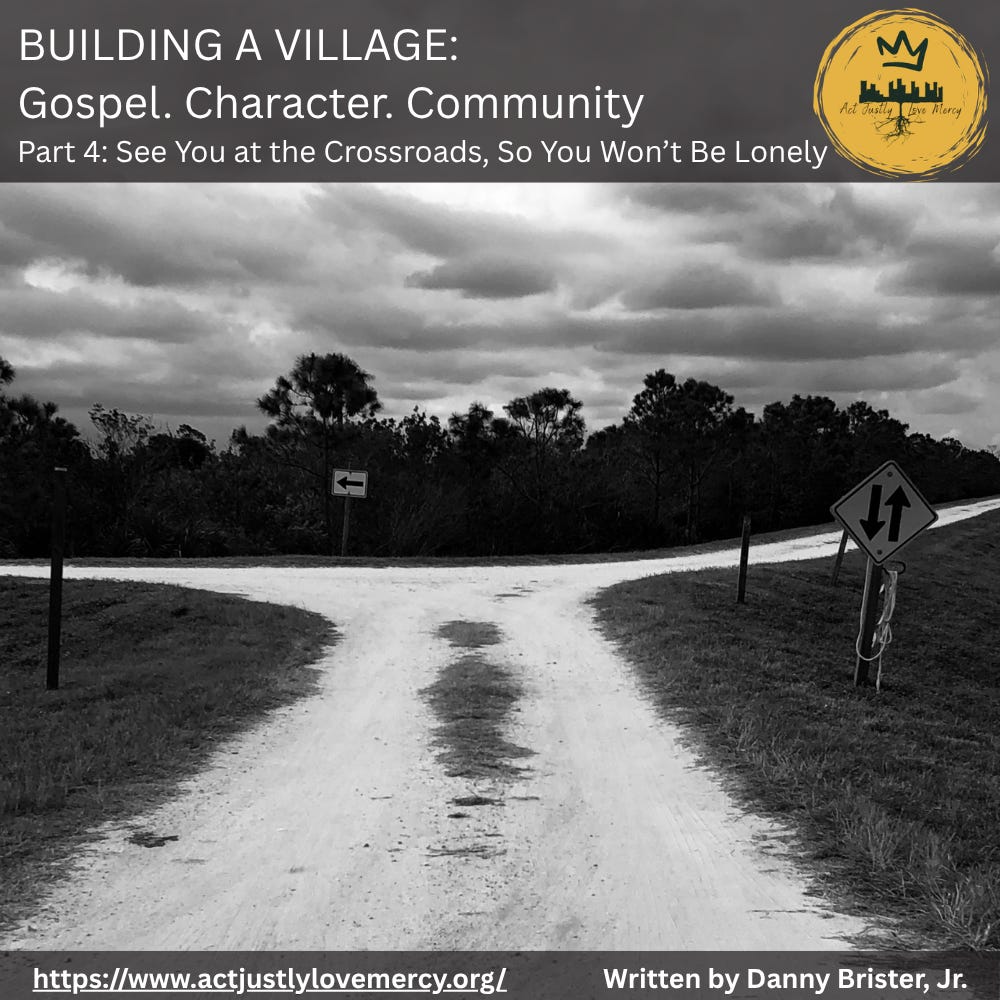
In the early 1990s, the hip-hop group Bone Thugs-N-Harmony released the song “Crossroads.” The music video opens with an all-too-familiar scene of Black people mourning the loss of a young man taken far before his time. As the mourners cry out, what appears to be the reaper of souls comes and takes the young man away. Throughout the video, this scene replays over and over as members recount the loss of a friend and loved one. The song spoke to how unpredictable so much of life is, and it was one group’s attempt to cope with the loss that often surrounds us.
The 80s and 90s were tumultuous for many people in urban and inner-city America. As gun and gang violence surged and crack cocaine flooded the streets, countless lives were lost. The murders of prominent figures in hip-hop shocked a generation. While those are familiar names, many others were gunned down in their homes and communities, while those accused of perpetrating the violence were sent off to prison to serve long sentences.
As people, we have often used art to process life’s complexities and grieve death. As I reflect on a particularly painful season of loss, I can’t help but think about all the people I’ve lost in recent years. Most of them were far too young, and yet their deaths happened all the same. So, to deal with my grief, I make art.
WHEN THE VILLAGE LOST TWO
When two close friends died within the same season, I began wrestling with the way we view and think about death. One was killed, shot in the back by someone he tried to help. He was a gentle, big man with a large heart; there was rarely a person he wouldn’t help. The other died while I waited in an emergency room a thousand miles from home, just 21 days after her 40th birthday. The first was barely in his 30s.
I had tasted the cold sting of death before.
Their deaths hit different.
They shook me.
Already reeling from the losses of the pandemic, my heart and brain couldn’t really deal with the magnitude of what I was experiencing. How can so much death, pain, and suffering happen? And why does it seem that these times of loss come in waves?
One of those losses occurred far from home, right before the launch of a significant program we were developing to serve students in our city. It’s hard to explain what it’s like to go to the emergency room with someone and leave without them. Within hours of accompanying someone to the ER, they had slipped away from this world into the next.
Loss changes you.
I didn’t know that.
Actually, I’ve come to believe it’s the grief that changes you.
“For we walk by faith, not by sight. We are confident, yes, well pleased rather to be absent from the body and to be present with the Lord.”
2 Corinthians 5:7-8
DEATH WAS NEVER GOD’S WILL
Death isn’t natural. We treat it as though it is because everyone will die, but it was ultimately outside of God’s original design. Death entered the world when humanity rebelled against God in Genesis 3. As believers, we embrace the truth that in Jesus, death has lost its sting and the grave has been stripped of its victory (1 Corinthians 15:55-57). We accept what Paul says: to be absent from the body is to be present with the Lord, and we don’t grieve like those with no hope. Yet we still grieve. The Apostle Paul says in Philippians 2 that God spared his friend from death to keep Paul from experiencing “sorrow upon sorrow.”
As I’ve thought about building a village and pursuing community flourishing, I can’t escape the thought of what happens when a member of our village dies. I want to see a world filled with flourishing, peace, and joy for everyone. Our society mocks those who pursue things like world peace, joking about it as if it’s unattainable. Why? Because we know how broken our world is. But as those who labor for the renewal and transformation of all things, we desire a world free from needless suffering. A world filled with peace. A world free from poverty, racism, and all types of injustice.
One of the lies I used to believe about death was, “It was just their time to go.” I’m not sure where this lie originated, but I don’t think it is biblical. It seems like more of an excuse to overlook all the contributing factors that lead to premature death. People, especially in the Christian world, say this and tie it to the sovereignty and providence of God, as if God’s will is done in the timing of our deaths and not in the living of our lives.
Jesus told his disciples to pray for God’s will to be done on earth as it is in heaven. Why does Jesus tell his followers to pray for this? Because on earth, God’s will isn’t always done. From Genesis 3, it wasn’t God’s will for humanity to rebel against Him. It wasn’t God’s will for Cain to kill Abel. Wars. Murder. Famine. Genocide. Racism. Violence against women. Slavery. Gun violence. All of these things have devastated our villages, families, and society. None of this, I’d consider God’s will.
We are called to push back the darkness in our villages, not embrace it. Instead of naming the injustices and evils that lead to premature death, we too often wash over them with faulty theological reasoning. Instead of fighting for a society where fewer people suffer at the hands of others, we make political arguments equivalent to “that’s not my problem” and spiritually over-realized eschatological statements. Not all suffering can be eliminated through our actions, but some suffering is unnecessary, born not of God’s will but out of human wickedness.
HOW DO YOU DEAL WITH THE PAIN?
Pain is a sign that something is not as it should be. It’s a message that something just isn’t right and requires our attention. Pain can be physical, mental, or emotional. It comes in many shapes and sizes and can manifest in any part of the body or in any area of our lives.
In her book Young, Gifted, and Black, Sheila Wise Rowe discusses why we grieve and how we often grieve in secret or in socially acceptable ways. She points to two famous Black men who died of cancer without many people knowing they were sick, continuing to work through their illness and giving everything to their craft. She calls them gifted men who were gravely ill and continued to work through their illness, noting that, while heroic, it is also truly sad.
This is the type of grief our culture often produces. Grief that suffers in silence. Grief that pushes through. But what about the things that cause us grief as individuals? How do we deal with the pain we experience when things fall apart?
“He is despised and rejected by men, a Man of sorrows and acquainted with grief. And we hid, as it were, our faces from Him; He was despised, and we did not esteem Him.”
Isaiah 53:3
We are not alone in our grieving. Grief can be described as sorrow, a deep sadness. And we have a Savior who is acquainted with it.
I learned to suffer in silence.
Dishonesty about my pain became my friend.
AFTERWARDS
I started this piece the week of Thanksgiving (2023). My hope was to publish it the following week. Little did I know that grief would come and revisit me.
I won’t recount the details. I’m not ready to walk through that day again. What I will share is that members of my team and I experienced another tragic and unexpected loss. Another shaking. Another member of the village was taken.
Grief.
I decided to take this piece in a different direction than it was initially intended. I kept the original sections that speak about those two earlier losses because I believe they illustrate how grief and loss disrupt our lives and plans. Often, things don’t end the way we would like them to, leaving us grasping for meaning and finality.
My life is in the midst of a change, an evolution. I am growing. Being stretched beyond what I previously believed I could endure. I am learning. Discovering that death is inevitable in our villages. That suffering, grief, and loss are beyond us at times. My roots are breaking through the hardened ground to find nourishment that helps me endure.
I recently met with a friend for lunch, and she shared that she could see I was changing. Maturing. But she told me, “Don’t lose your joy.” Count it all joy when you fall into various trials, knowing that the testing of your faith produces patience. God is at work in our villages, even amid our suffering.
My wife and I recently had a conversation about joy. She asked me, “When the Bible speaks of joy, what do you think it means?” After pausing to consider what the Bible says, I shared that I believe joy means continuing to live. To not allow the pain of life to rob us of life’s beauty. The darkness of suffering can dim our hearts and cause us to close our lives to others. Rejoicing in suffering reminds us that suffering is not all there is. There is more. So much more.
A NOTE FROM 2026
When I wrote those words about joy in early 2024, I didn’t fully know what they would become for me. Two years later, joy is my anchor word for 2026. It’s drawn from Philippians 4:4-9, Paul’s letter written not from a place of comfort but from a prison cell. “Rejoice in the Lord always. Again, I will say, rejoice.”
Paul wasn’t telling us to pretend. He wasn’t asking us to perform happiness over grief. He was pointing us toward something deeper than our circumstances. A joy that endures precisely because it isn’t dependent on things going well. A joy that keeps you living even when the village has been shaken.
That’s what I was reaching for when I wrote this post. And that’s what I’m still reaching for now. Not because the grief is gone, but because the village needs people who have learned to carry both.
The End.
I would love to hear from you about the grief, suffering, and loss you’ve walked through and how you are learning to rejoice and lean into your village. Leave a comment below or reach me directly.
ABOUT THIS SERIES:
Building a Village: Gospel. Character. Community is a four-part series about what it takes to pursue transformation in yourself, your family, and your community. It begins with God doing a work in us, moves through the lessons proximity and humility teach, honors those who shaped us, and ends here, with the grief that is an unavoidable part of village life. Thank you for reading. If these posts have meant something to you, share them with someone who needs them.