

EDITOR’S NOTE:
This is Part 2 of the refreshed Building a Village series, originally published in two parts in late 2023. I’ve merged and updated both pieces here because the story they tell belongs together. If you haven’t read Part 1 yet, I’d encourage you to start there.
“Not everything that is faced can be changed, but nothing can be changed until it is faced.”
~ James Baldwin,
As Much Truth as One Can Bear (NYT, 1962)
During the fall of 2018, I had the opportunity to visit New York City for the first time. As a native of Birmingham, AL, I was enthralled with how massive and concrete the city was. Buildings everywhere. I know New York is known as the concrete jungle, but it was the first time I’d been to a city with so little greenery. Birmingham is known as Tree City, USA, and many people are shocked when they first visit to see how much of it we have, sitting in the foothills of the Appalachian Mountains. So imagine my surprise when the only greenery I saw was little planted trees outside of office buildings and apartment complexes.
While I was captivated by the abrupt change of scenery, the concrete buildings, swirling snow (It was swirling, y’all, I felt like the little orphan Annie the first time she visited Daddy Warbucks), and freezing temperatures were not why I visited. I was there to receive training at the Red Hook Community Justice Center, part of The Center for Justice Innovation. The training focused on restorative peacemaking rooted in Native American practices. At the time, I worked for the City of Birmingham Mayor’s Office, and we were looking to expand the use of deferrals and restorative practices in our municipal justice system. The program brought together disputants, family members, and community members to discuss how a disruptive event affected each person. The purpose was not only to resolve the immediate dispute but to heal the relationships involved and restore balance to the community.
THE WORK THAT SHAPED ME
To understand why I ended up in Brooklyn that fall, you have to understand what the previous four years had been. In February 2014, President Obama launched My Brother’s Keeper (MBK), an initiative that connected cities, nonprofits, education systems, businesses, and philanthropists to improve outcomes for boys and young men of color. Birmingham became the second city in the nation to sign on to the MBK Community Challenge, and for the next five years, I reoriented much of my work around helping our city build systems and strategies to meet its goals.
I spent countless days and nights reading everything I could to better understand the scope of our city's challenges. I met with leaders from the grassroots to the “grasstops.” I worked alongside consultants from Bloomberg Associates, community leaders, and business leaders to develop a holistic strategy for funding and policy change. Spurred by the pursuit of a better, more opportunity-rich Birmingham, I devoted my energy to the work of system transformation.
Unfortunately, by 2018, I had grown disillusioned. The local MBK program had died a political death. While much activity went into the initiative, little substantive policy or funding followed. President Obama was no longer in office, and the mayor who launched the cause locally lost a hotly contested election in 2017. The program had already begun to lose its potency before then due to unclear leadership, an ongoing political campaign, and uncertainty over funding. I had invested years of my life into this work, and I was beginning to question whether the change I wanted to see could actually be accomplished through government.
In 2018, I applied to the American Express Leadership Academy Points of Light Cohort and was accepted as one of 25 national up-and-coming civic and nonprofit leaders. The experience was enriching but still incomplete. So later that year, I found myself in Brooklyn learning about peacemaking, being recruited to join a different city department, and quietly wrestling with a growing conviction: that it was time to take my passion from city government to building organizations and institutions at the local community level.
BUILDING SOMETHING NEW
Out of my disillusionment grew a desire to create systems and institutions that worked for all and not just some. This led me to join the launch team of a charter school opening in a community where I had invested significant time and energy.
Being a founding member of that team re-energized me. We set up shop in a small, open office and went to work creating a space for students to explore their curiosity about the world. A place of belonging and innovation. I loved every exhausting moment of it. We aimed to open Alabama’s largest charter school, serving 420 students from Kindergarten through 5th grade. We planned and debated how to create a culture filled with high expectations, love and support, and family engagement. It was all heady stuff. But it didn’t just stay in the head. It forced us to engage our hearts and hands as we set about this transformative work.
I led the team responsible for recruiting students and their families to take a chance on an unknown entity with high hopes. We knew that if we were going to succeed in enrolling 420 students, we would need to recruit three times that many to account for inevitable attrition.
THERE ARE NO CHILDREN HERE
“In many ways, the labyrinth of my life is leading back to where I began and to many of the lessons learned but too easily lost in the cacophony of noise and clutter and triviality and depersonalization afflicting so much of modern American life and culture. With others, I seek to reweave the frayed remnants of family, community, and spiritual values rent asunder in the name of progress.”
~ Marian Wright Edelman
Founder of The Children’s Defense Fund
One evening, I was attending a community event, sharing the school's vision and my philosophy on family engagement and education. I was going through my usual spiel when I was challenged by a longstanding community champion. Her name was Ms. King.
I was in the middle of saying, “I believe that every parent wants what’s best for their child…” She stood up and asked, “Why do you believe that?” I began to tell her my thoughts on a parent’s love for their child, and how parents, even if they don’t know how to offer what’s best, still desire what’s best for their children.
I waxed eloquently.
She saw right through it.
A long conversation ensued. What can I say? I was still preoccupied with my vision of what it took to transform communities. But as our conversation went on, I began to listen to what she had to say, and by the end of the night, I was more aware than ever of just how much I had to learn. She told me that if I was serious, I should read the book There Are No Children Here by Alex Kotlowitz. Her exact words were: “I’ll see how serious you are if you read the book. Come talk to me once you do. I’m not hard to find.”
When I finally got back home that night, exhausted after being challenged to think deeper about the complexities of transforming and engaging communities, I sat down on my couch, took out my phone, and ordered the book.
A few days later, I found myself immersed in the lives of the Rivers family as they navigated life in the Henry Horner Homes in Chicago, IL. I tore through the book, making notes and asking questions about the people it described. I pondered the plight of its main characters and sought meaning amid such abject poverty. I looked at this book, published only four years after my birth, and wondered how it was still possible that we were struggling with so many of the same challenges. And I felt that old, familiar feeling of grief, despair, and hopelessness begin to creep in.
These were not unfamiliar themes. In my previous studies and experience, I had wrestled with poverty, drug abuse, violence, and the hopelessness that is all too common in settings like those in the book. I had led a church plant in the middle of Birmingham’s most impoverished and largest housing community. But something felt different this time. Maybe it was the conversation with Ms. King. Maybe it was the daily work I was doing on the ground. Whatever it was, I needed someone to help me navigate what I was feeling.
A couple of weeks later, I looked for Ms. King and found her at the Harris Homes Community Center, a public housing community where I once ran a mentoring program. She smiled when I walked in and asked how I’d been. I told her I was good, but I needed serious help. She stared at me briefly with a sly smile and finally asked, “Did you get that book?” Relieved that she asked, I told her I had and that it brought up so many questions.
I shared how, while reading the book, I couldn’t help but judge the people and situations they faced. I shared my thoughts on the Rivers family and their struggles, and how I was tempted to condemn Lajoe, the mother, for her choices and for having so many children. Something that we are, either consciously or subconsciously, conditioned to do because of how our society treats women of color. I assumed, as many would, that she was unmarried. I was wrong. Lajoe was married to a man she loved, the father of all her children, but he struggled with addiction. I expressed to Ms. King my shame at the judgments that rose up in me as I read.
As we spoke, she shared her own life story with me. She spoke about being a single mom and raising three boys. She told me how she went back to college to obtain her teaching degree, and how she labored to give her sons the opportunities so many around her couldn’t afford. She became a mentor to me. When she saw my sincerity and my seriousness, she committed herself to being a champion on my behalf. We would sit and talk for hours at the community center or at community events.
She would acknowledge that my thoughts about the work weren’t wrong, but she had seen many young and eager individuals come and speak about things they didn’t fully understand. This was her way of testing me. She told me she had issued the same challenge and invitation to others, and that I was the first to take her up on it.
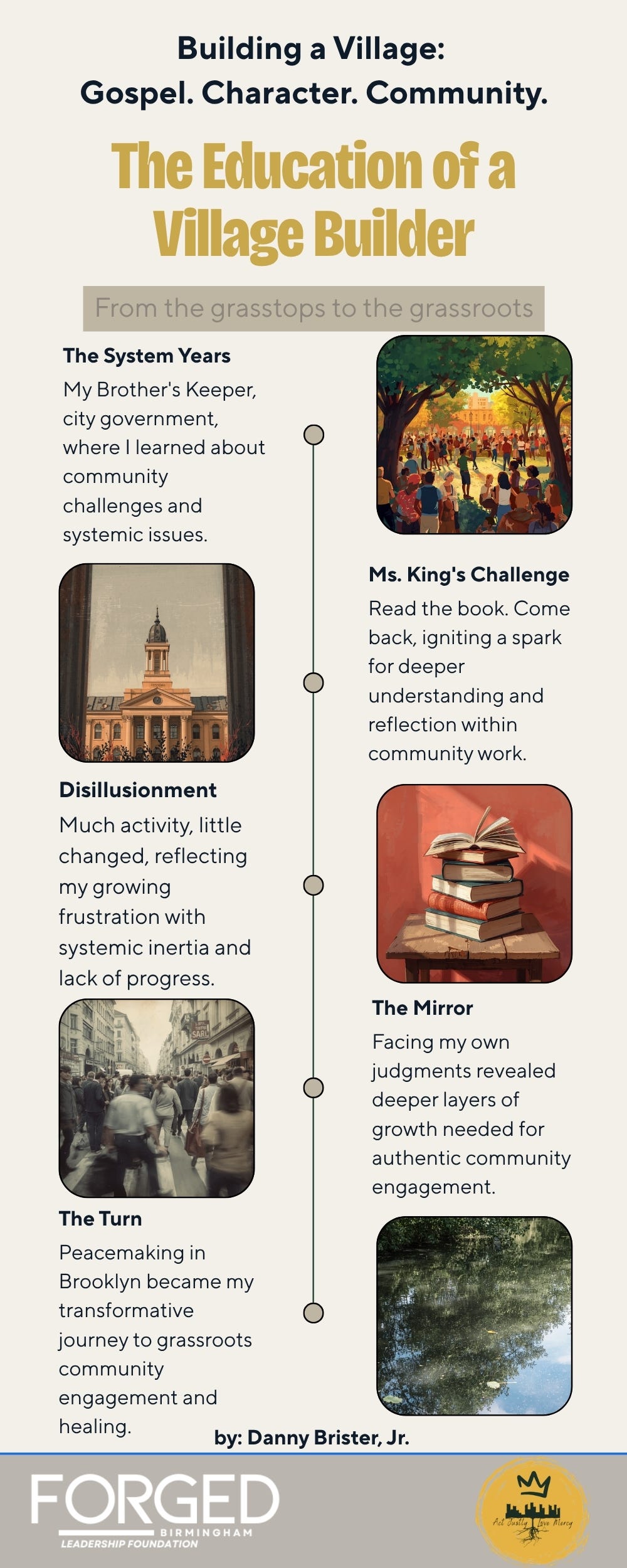
WHAT MS. KING TAUGHT ME ABOUT BUILDING VILLAGES
I think about Ms. King often. She is one of the unsung village builders I have had the privilege of learning from. She didn’t have a title. She wasn’t on anyone’s organizational chart. But she had something that no program or policy could manufacture: presence, proximity, and the hard-won wisdom that only comes from staying.
What she modeled for me was something I had talked about but hadn’t yet fully lived. In Part 1, I wrote about the importance of starting with God and allowing that transformation to work its way out in you before you try to work it out in the world. Ms. King was living proof of that principle. She wasn’t trying to transform the community from a distance. She was in it. She was of it. And because of that, she had the kind of credibility and trust that no resume could earn.
That season taught me three things I carry into every room I walk into now:
Proximity is not optional. You cannot build a village you are not willing to live in. The most important thing you can do before you develop a strategy is show up and stay long enough to be known.
Posture matters more than expertise. I walked into that room in Woodlawn with answers. Ms. King taught me to come with questions. Humility is not weakness; it is the prerequisite for learning.
The gatekeepers can be teachers. Every community has people like Ms. King: those who have seen people come and go, who are watching to see if you’re serious. Don’t be offended by the test. Pass it.
These lessons didn’t just shape me personally. They became foundational to the work of Forged: Birmingham Leadership Foundation, where we believe that developing whole leaders requires the kind of formation that happens in community, not just in classrooms. The village we are trying to build together has to be rooted in the same soil we are asking others to tend.
In Part 3, we will move further into the framework and discuss what it looks like to engage the community in a way that is sustainable, rooted, and real.
I’d love to hear from you. Who has been your Ms. King? The person who slowed you down long enough to teach you something you didn’t know you needed to learn? Leave a comment below or reach me at dannyb@actjustlylovemercy.org.